Can Allulose Replace Sugar?
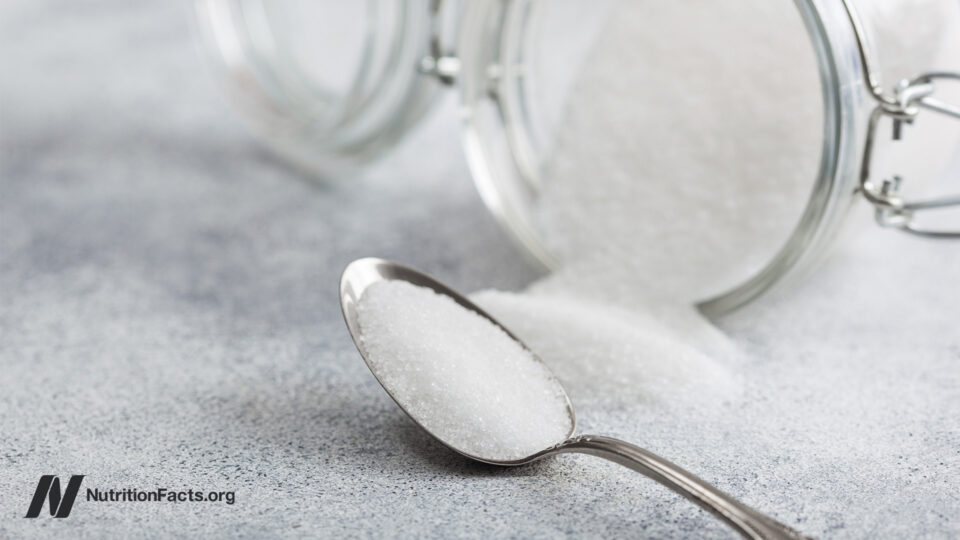
How safe are fourth-generation sweeteners, such as the rare sugar allulose?
First, there was sugar and high-fructose corn syrup, the original industrial sweeteners. They were cheap, but they had lots of empty calories and contributed to diseases such as obesity, type 2 diabetes, cavities, and metabolic syndrome. Then came the second-generation sweeteners, the artificial sweeteners in the colored pastel packets: NutraSweet, Splenda, and Sweet’N Low. They have practically zero calories, but there have been reports of adverse effects, prompting caution. For example, artificial sweeteners were found to induce glucose intolerance by altering the gut microbiome, thereby producing “the counterintuitive effect of inducing metabolic derangements.” (They also taste kind of funny.) Enter the third-generation sweeteners: sugar alcohols, such as sorbitol, xylitol, and erythritol. They’re low-calorie sweeteners; however, their laxative effects can create difficulties. That brings us to rare sugars like allulose, which are natural sweeteners with a sugar-like taste and low or zero calories.
For those who haven’t heard of allulose, it’s been through a bit of a rebranding—kind of like the morphing of rapeseed oil into canola oil, which forced a Canadian community to update its town slogan, as you can see below and at 1:29 in my video Does the Sweetener Allulose Have Side Effects?.
Allulose used to be called psicose, derived from the antibiotic from which it was isolated, a strange origin story for a sweetener. In the journal Frontiers in Bioengineering and Biotechnology, emphasis is placed on the fact that allulose is “a real and natural sugar rather than an artificial sweetener,” but, ironically, if you look at the reference it cites, it talks about how allulose is made via “functionalized polyhydroxyalkanoate (PHA) nano-beads decorated with D-tagatose 3-epimerase (DTE)” and “produced in recombinant endotoxin-free” branded bacteria.
Now, technically, allulose is a natural sugar—a so-called rare sugar, which the International Society of Rare Sugars defined as sugar that is “present in limited quantities in nature.” However, recent advances in technology, such as enzymatic engineering using genetically modified microorganisms, now let manufacturers produce otherwise rare sugars like allulose in substantial quantities. But small amounts have pre-existed in the food supply, so the U.S. Food and Drug Administration granted it “generally recognized as safe” status. However, that designation refers to really small amounts, like a few dozen milligrams, or a quarter of a quarter of a quarter of a teaspoon. You can see the allulose content in different foods below and at 2:51 in my video.
See, allulose is generated when fructose is heated. That’s why one unlucky patient kept breaking out in hives when eating foods like spaghetti, hamburgers, or cakes—he happened to be allergic to allulose, and allulose is created incidentally in the process by which high fructose corn syrup is made. So, basing the safety of allulose on the fact that it’s already been present in our food supply isn’t very convincing. You don’t know if it’s safe until you put it to the test.
Unlike table sugar, allulose is safe for the teeth—it isn’t apparently metabolized by cavity-causing bacteria to make acid and build up plaque. It doesn’t raise blood sugars, even in people with diabetes. It can be labeled as having zero calories, though technically it may have about one and a half calories per teaspoon, similar to erythritol. Also like erythritol, it is only about 70% as sweet as table sugar but has almost the same taste, texture, and performance as regular sugar. Are there any toxicities?
Allulose is considered a “relatively nontoxic” sugar. What does that mean? Well, we know a sweetener called xylitol can be extremely dangerous to dogs. As little as a half teaspoon in a 30-pound dog can be life-threatening, whereas a similar dose of allulose apparently wouldn’t be a problem, though more than half a cup at a time could make them sick. This was a single-dose study, though. The long-term safety of allulose was tested over a period of a few months and didn’t seem to cause any harmful effects at a dose of about one and a half teaspoons a day for healthy 30-pound dogs. In fact, their cholesterol actually went down, leading the investigators to suggest clinical studies to see if it’s something veterinarians should start prescribing for overweight pooches.
What happens when people consume allulose? When the dose was gradually increased to identify the maximum single dose that could be consumed occasionally, no severe gastrointestinal symptoms were noted until a dose of 0.4 g/kg of bodyweight was reached, which may be about 7 teaspoons, with severe symptoms of diarrhea occurring at around 9 teaspoons. One might wonder who could eat that much sugar at a time, anyway? A single can of Coke has 10 teaspoons, and a bottle of Mountain Dew has nearly twice that, as you can see below and at 5:19 in my video.
So, allulose is clearly not suitable as a standalone sweetener for sugary beverages.
In terms of a daily upper limit given in smaller doses throughout the day, once intake reaches around 17 teaspoons a day, depending on body weight, people start getting severe nausea, diarrhea, abdominal pain, and headaches. So, people should probably stay under single doses of about 7 teaspoons and not exceed about 15 teaspoons for the whole day. The average American may be getting 17 teaspoons of added sugars a day, so it’s certainly not something the food industry can completely switch over to.
In this way, allulose is close to xylitol in terms of maximum single dose, whereas an average-weight man in the United States could get away with 14 teaspoons of erythritol at a time, and an average-weight woman, 15 teaspoons. That’s still not enough to sweeten a bottle of Coke, but it offers a little more leeway for sweetening tea or sprinkling on a grapefruit.
Allulose is claimed to provide health benefits, though, compared to erythritol. Fourth-generation sweeteners like allulose are said to have an advantage: “additional functions,” which you can see below and at 6:28 in my video.
We’ll find out if that’s true in the next blog.
Doctor’s Note
Are Rare Sugars Like Allulose Actually Healthy? That’s the next blog.
I’ve covered a range of other sweeteners before in these videos:
Aspartame and the Brain
Erythritol May Be a Sweet Antioxidant
Aspartame-Induced Fibromyalgia
Effect of Sucralose (Splenda) on the Microbiome
Does Aspartame Cause Cancer?
Is Monk Fruit Sweetener Safe?